
1. Why is RPS considering these changes now?
Rochester Public Schools is reviewing several facilities changes because the district must align its buildings with student needs, program needs, projected declines in student enrollment, and long-term financial realities.
Like many school districts, RPS is facing enrollment pressures, rising facility costs, and inadequate state and federal funding. That means we need to use our physical and financial resources as efficiently as possible. A major driver of this proposal is also the need to move programs out of the Friedell building, which would require significant future investment if the district continued to use it.
2. What exactly is RPS proposing for Churchill-Hoover, Churchill, Hoover, Gage, MS ALC, and RAIL?
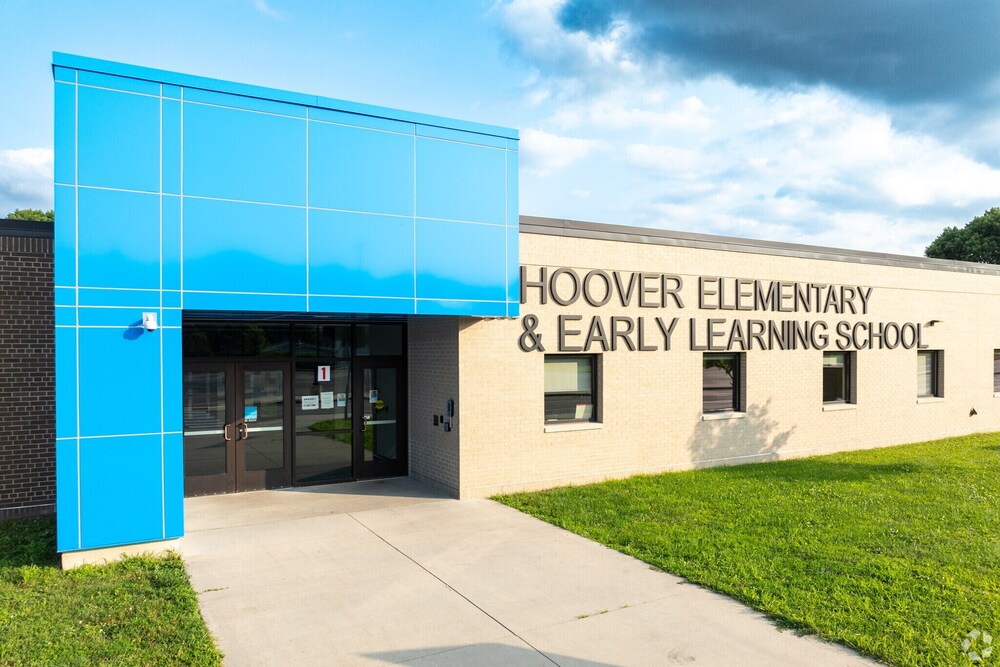
RPS is considering a connected set of changes. Students in grades K–2 who currently attend school in the Churchill building would move to Hoover, where grades 3–5 are currently located. This would create one unified K–5 Churchill-Hoover school in the Hoover building.
To make space at Hoover, some Early Learning classrooms currently at Hoover would move to Gage Elementary. The Churchill building would then become the long-term home for the Middle School Alternative Learning Center and the Rochester Academy for Independent Living, known as RAIL. RAIL would also receive a purpose-built addition at Churchill.
The proposal would not change the Churchill-Hoover attendance boundary, and nearly all Churchill staff would move with students to Hoover. If approved, the changes would take effect for the 2027–2028 school year.
3. Is RPS closing Churchill Elementary School?
RPS is not proposing to sell or abandon the Churchill building. However, the proposal would change how the building is used.
Under the proposal, Churchill would no longer serve K–2 elementary students. Those students would become part of a unified K–5 Churchill-Hoover school at Hoover. Churchill would remain an RPS facility serving students through the Middle School ALC and RAIL.
We understand that this would be a meaningful change for families and neighbors who value Churchill as a K–2 neighborhood school. The goal is not to diminish Churchill’s importance, but to use the building in a way that better meets districtwide student and program needs.
4. Would the Churchill-Hoover attendance boundary change?
No. The proposal would keep the existing Churchill-Hoover attendance boundary. Students would not be reassigned to other elementary schools. Instead, the current Churchill-Hoover school community would be brought together in one building at Hoover.
5. Would Churchill staff move with students to Hoover?
Yes. Nearly all Churchill staff would move with students to Hoover.
That is an important part of the proposal. The goal is to preserve the relationships students and families have with Churchill staff while creating one unified K–5 school community.
6. When would the changes take effect if approved?
If approved by the School Board, the changes would take effect for the 2027–2028 school year.
That timeline would give the district time to complete needed building modifications, plan transitions carefully, communicate with families and staff, and prepare students for the move.
7. Why does RPS believe a unified K–5 school is better than the current split-campus model?
Churchill-Hoover is the only elementary school in RPS that operates as one school across two separate campuses. Grades K–2 are at Churchill, and grades 3–5 are at Hoover.
Staff and families have worked hard to make that structure successful, but it creates barriers that would not exist in a single K–5 building. A unified school would make it easier for K–2 and 3–5 teachers to collaborate, provide student supports across grade levels, create shared schoolwide traditions, and strengthen family engagement.
It would also eliminate the transition students currently make after grade 2 and allow students to remain in one school community throughout their elementary years.
8. Why move grades K–2 to Hoover instead of moving grades 3–5 to Churchill?
Hoover is the larger building and is better able to accommodate the full K–5 Churchill-Hoover school community while preserving the existing attendance boundary.
Churchill is not large enough to serve the full current K–5 attendance area without a major addition, a smaller attendance area, or the reassignment of some students to other schools. Churchill is better suited for smaller, specialized programs such as the Middle School ALC and RAIL.
9. What changes would be made at Hoover to serve younger students and manage arrival and dismissal safely?
Hoover would be modified to serve younger students appropriately. Planned work would include classroom updates, restroom modifications, sink-height changes, playground-related improvements, traffic and parking improvements, and other updates needed to support K–2 students.
Arrival and dismissal planning would also be part of implementation. The district would plan traffic flow, supervision, family communication, and student movement so that younger students can enter and leave the building safely.
10. What are the Middle School ALC and RAIL, and why do they need different long-term facilities?
The Middle School Alternative Learning Center serves students who need a smaller, more supportive setting to reconnect with school, close academic gaps, and address challenges such as anxiety, depression, mental health needs, or interrupted learning.
RAIL serves young adults with disabilities, ages 18–22, who are preparing for employment, independent living, postsecondary opportunities, and active participation in the community.
Both programs are currently located at Friedell, a building with significant long-term facility challenges. RPS believes students in these programs deserve stable, high-quality spaces designed around their needs.
11. Is Churchill being repurposed only for a small number of Middle School ALC students?
No. The Middle School ALC currently serves 70 students and would expand to serve 120 students if this proposal is approved and the program is relocated to the Churchill building.
In addition, Churchill would not serve only the Middle School ALC. The proposal would also make Churchill the long-term home for RAIL, a transition program for young adults with disabilities that needs additional, purpose-built space.
In other words, the proposal is about creating a long-term home for two important programs, moving out of the Friedell building, reducing future facility costs, and using district-owned space more effectively.
12. Who are the students served by the Middle School ALC, and would they bring behavioral challenges to the neighborhood?
The Middle School ALC serves RPS students who need a smaller, more supportive learning environment. Many students served by the program are working through anxiety, depression, mental health needs, academic gaps, or interrupted learning.
It would not be accurate to describe these students as students with major behavioral problems. They are Rochester Public Schools students who deserve support, structure, dignity, and the opportunity to succeed.
As with any school, RPS would establish clear procedures for arrival, dismissal, supervision, transportation, visitor access, student movement, site security, and communication with nearby residents.
13. Why does RPS believe Churchill is an appropriate location for MS ALC and RAIL?
Churchill provides available district-owned space, is the right size for smaller programs, and allows RPS to create better long-term facilities for MS ALC and RAIL while moving out of the Friedell building.
The site also supports the broader facilities strategy. It allows RPS to bring Churchill-Hoover students together at Hoover, use Churchill for specialized programs, reduce reliance on the Friedell building, and avoid major future investment in a building that is not the best long-term solution.
14. Would RAIL students have appropriate access to public transportation and community-based instruction at Churchill?
Yes. RPS recognizes that public transportation and community-based instruction are central to RAIL’s mission.
The district reviewed this issue with RAIL leadership, Rochester Public Transit, and the RPS Transportation Department. Based on that review, RPS has confirmed that RAIL students’ transportation and community-access needs can be met at the Churchill site.
15. How large would the RAIL addition be, and how was its size determined?
The proposed RAIL addition would include approximately 12 classrooms, administrative space, conference rooms, health office facilities, staff support spaces, and shared-use areas.
The size is based on the nature of the RAIL program. RAIL is not a traditional classroom program. Students need spaces for independent living instruction, vocational training, employment readiness, health services, family and provider meetings, student supports, and community-based learning.
16. How much would the RAIL addition cost, and how would it be funded?
The estimated cost of the RAIL addition at Churchill is $16.621 million.
The current funding strategy identifies lease-purchase financing as the potential funding source for that portion of the proposal. Before a final recommendation is brought forward, RPS will continue to analyze cost, funding sources, taxpayer impact, and long-term affordability.
17. What physical changes would be made at Churchill, including the RAIL addition, parking, playground, and outdoor areas?
The most significant proposed change at Churchill would be the addition designed for RAIL. The building would also need modifications to support MS ALC and RAIL operations, including student support spaces, health-related spaces, secure entry and circulation, and other program-specific needs.
Site planning would also address parking, traffic flow, playground access, green space, and neighborhood impact. RPS understands that the outdoor areas at Churchill are important to families and neighbors, so final site planning would need to preserve meaningful outdoor space while also creating the specialized learning spaces RAIL students need.
18. What would happen to the Churchill playground, green space, tennis courts, ice rink, and basketball court?
The Churchill site would change, but it would not lose its outdoor character.
Current planning includes maintaining the playground as a shared asset for students and the neighborhood and ensuring that it is accessible. The tennis courts located on school district property through an agreement with the City of Rochester would remain in place. The adjacent ice rink, which is located on city-owned property, would remain as it is.
RPS also understands that the playground, green space, basketball court, tennis courts, and ice rink are important neighborhood assets. Those issues would be considered carefully in final site design.
19. Would the neighborhood have input into playground, parking, and site-design decisions?
Yes. If the School Board approves moving forward, RPS would continue working with families, staff, and neighbors as site design becomes more detailed.
That input would be especially important on issues such as playground access, green space, parking, traffic flow, arrival and dismissal, and how the Churchill site can continue to serve students while remaining a positive presence in the neighborhood.
20. How would the proposal affect traffic, parking, winter safety, and emergency access in the Churchill neighborhood?
The daily traffic pattern at Churchill would change, but RPS does not believe the proposal would create more parent drop-off and pick-up congestion than exists today. The number of RPS bus routes serving MS ALC and RAIL would be nearly identical to the number of routes currently serving Churchill students. In addition, MS ALC and RAIL students are generally not dropped off and picked up by parents in the same way elementary students are.
RPS would still need to plan carefully for parking, winter conditions, emergency access, service vehicles, construction activity, and communication with nearby residents. Those details would be part of the implementation and site-planning process.
21. What alternatives did RPS consider before recommending this proposal?
RPS considered multiple alternatives before recommending the current proposal. Those included maintaining MS ALC and RAIL at Friedell, relocating MS ALC to Gage, relocating MS ALC and RAIL to Sunset Terrace, relocating RAIL to ESC, renovating ESC for RAIL, and other facility configurations.
Several alternatives were eliminated because they involved greater cost, transportation challenges, capacity limitations, operational concerns, or greater disruption to students, families, staff, or programs.
22. Why not keep MS ALC and RAIL at Friedell?
The Friedell building has served MS ALC and RAIL well for the past several years, but it is not a viable long-term solution.
The building has significant facility limitations and deferred maintenance needs. Continuing to invest in Friedell would make it harder for RPS to address broader facility needs responsibly. Moving MS ALC and RAIL to Churchill would allow the district to move out of Friedell, reduce future maintenance exposure, and create more appropriate educational space for both programs.
23. How much would the Churchill-Hoover/Gage/MS ALC portion of the proposal cost?
The estimated cost for the Hoover, Gage, and Churchill renovations connected to the Churchill-Hoover consolidation, Early Learning relocation, and MS ALC relocation is $3.538 million.
That estimate includes work such as classroom updates, restroom modifications, playground-related changes, sink-height modifications, traffic and parking improvements, locker accommodations, and Early Childhood spaces.
24. How would the projects be funded, and would they affect taxpayers or classroom funding?
RPS is analyzing several funding sources, including cash reserves, capital facilities bonds, Long-Term Facilities Maintenance funding, lease-purchase financing, and potential Friedell sale proceeds.
The district’s goal is to match each project with the most appropriate funding source while minimizing borrowing, limiting interest costs, protecting classroom funding, and preserving long-term financial flexibility. Before a final recommendation is made, RPS will continue analyzing taxpayer impact, general fund impact, reserve impact, and long-term affordability.
25. Has the School Board already made a decision?
No. The superintendent and administrative team are developing final recommendations, which have not yet been submitted to the RPS School Board. The Board will receive the superintendent’s recommendation at its meeting on July 21, 2026, and will vote on the proposal at its meeting on August 4, 2026.